Types of Active and Passive Movement in Physio: A Complete Guide
Passive movement, active movement, and the shades in between form the backbone of almost every physiotherapy program. Here is every type of movement used in physio, the science behind each, and how a therapist decides which fits which stage of recovery.
If you have ever had a physiotherapist gently bend your knee for you, or asked you to lift your own arm against light resistance, you have already experienced the two pillars of movement therapy: passive movement and active movement. These two categories, along with the shades in between, form the backbone of almost every physiotherapy program, whether you are recovering from surgery, managing a stroke, treating a sports injury, or simply trying to move without pain again.
Understanding the types of active and passive movement in physio is not just useful for physiotherapy students. Patients and caregivers who understand why a therapist chooses one type of movement over another tend to follow their home exercise programs more consistently and recover faster. This guide breaks down every type of movement used in physiotherapy, explains the science behind each one, and shows how a physiotherapist decides which movement fits which stage of recovery.
What Do "Active" and "Passive" Mean in Physiotherapy?
In physiotherapy, movement is classified based on who or what is generating the force that moves the joint.
Active movement happens when the patient's own muscles contract to produce the motion. The nervous system sends the signal, the muscle shortens or lengthens, and the joint moves as a direct result of the patient's effort.
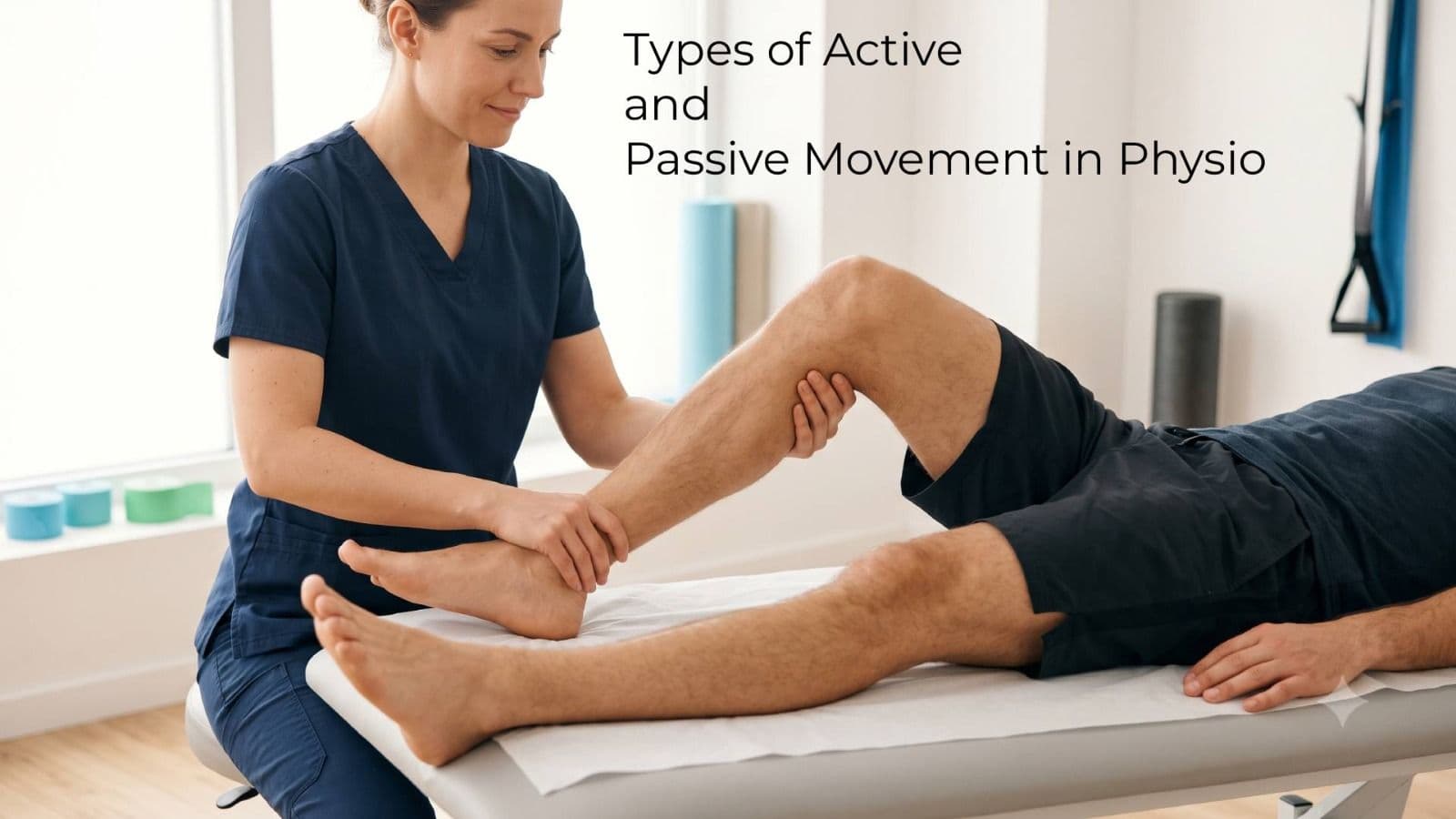
Passive movement happens when an external force, a physiotherapist's hands, a caregiver, gravity, or a mechanical device, moves the joint through its range while the patient's muscles stay relaxed. No voluntary muscle contraction is involved.
Between these two extremes sits a third, frequently overlooked category called active-assisted movement, where the patient contracts their muscles as much as they can while an external force helps complete the rest of the range. Most rehabilitation programs move a patient through all three stages in sequence, starting passive, progressing to active-assisted, and finishing at fully active and resisted work.
This classification matters clinically because each type stimulates the body differently. Passive movement maintains joint nutrition and tissue length without demanding muscle strength. Active movement builds strength, coordination, and neuromuscular control. Choosing the wrong type at the wrong stage can slow recovery or, in some cases, cause harm.
Types of Active Movement in Physiotherapy
Active movement is further divided based on how much external help the patient receives and whether the movement is under conscious control.
1. Active Free Movement (Active Range of Motion)
This is movement performed entirely by the patient's own muscle power, without any assistance or resistance from an outside source, other than gravity. Active range of motion, often abbreviated as AROM, is used to assess muscle strength, coordination, and how much a joint can move under a patient's own control. It is typically slightly less than the passive range of the same joint, because muscle tightness and voluntary effort limit the end range.
Common examples include raising an arm overhead, bending and straightening the knee while seated, or turning the neck side to side without help. Active free movement is usually introduced once pain and swelling have settled enough that the patient can move the joint safely on their own.
2. Active Assisted Movement (AAROM)
Active-assisted range of motion is used when a patient can initiate a movement but does not have enough strength, or has too much pain, to complete the full range alone. A therapist, a caregiver, a resistance band, a pulley system, or even the patient's own unaffected limb provides just enough support to finish the motion.
This type is common after shoulder surgery, stroke, or any condition involving muscle weakness. It bridges the gap between passive movement and fully active movement, encouraging the nervous system to keep firing the right muscles while reducing strain on healing tissue.
3. Active Resisted Movement
Once a patient can comfortably complete active free movement, therapists introduce resistance to build strength. This resistance might come from body weight, resistance bands, dumbbells, weighted cuffs, or manual resistance applied by the therapist's hands. Active resisted exercises are the foundation of strength-based rehabilitation and are essential before a patient returns to sport, heavy lifting, or independent daily activity.
Resisted movement can be further broken down by muscle contraction type:
- Isometric contraction: the muscle contracts but the joint does not move, useful for very early strengthening when motion is restricted.
- Isotonic contraction: the muscle changes length while the joint moves, either concentrically (muscle shortens) or eccentrically (muscle lengthens under control).
- Isokinetic contraction: the joint moves at a constant, controlled speed, usually with specialized equipment, often used in sports rehabilitation.
4. Active Involuntary Movement
Not all active movement is consciously controlled. Involuntary active movements include:
- Reflex movements, such as the automatic withdrawal of a hand from a hot surface.
- Associated movements, involuntary movement in one part of the body that accompanies a voluntary movement elsewhere, commonly observed in neurological conditions such as stroke or cerebral palsy.
Neurological physiotherapists pay close attention to these involuntary patterns because they offer clues about muscle tone, spasticity, and how the nervous system is recovering.
Types of Passive Movement in Physiotherapy
Passive movement is broadly classified into three types based on the purpose, force applied, and who or what performs the movement.
1. Relaxed Passive Movement
This is the gentlest and most common form of passive movement. The physiotherapist moves the joint smoothly and rhythmically through the available pain-free range while the patient stays completely relaxed. The goal is not to stretch or force the joint further, but to maintain the joint's existing mobility, keep synovial fluid circulating, prevent stiffness, and preserve the memory of normal movement patterns in the nervous system.
Relaxed passive movement is the go-to choice immediately after surgery, during periods of immobilization, for unconscious or paralyzed patients, and in early stroke rehabilitation when a limb cannot yet move on its own. It also includes accessory movements, small, specific glides and rolls within the joint that a patient cannot produce voluntarily but that are essential for full, pain-free range of motion.
2. Forced or Manipulative Passive Movement
Forced passive movement takes the joint slightly beyond its current available range using controlled overpressure, applied by a trained physiotherapist. Because this technique carries a higher risk of tissue damage if performed incorrectly, it is used selectively, mainly to break down early adhesions, address specific joint restrictions, and restore range that has been lost due to stiffness or scar tissue formation.
This technique differs from manipulation, which typically involves a fast, small-amplitude thrust at the end of a joint's range, most often used by qualified professionals for specific joint restrictions. Both approaches require sound clinical judgement, correct patient positioning, and an accurate diagnosis before use.
3. Continuous Passive Motion (CPM)
Continuous passive motion uses a mechanical device to move a joint slowly and repeatedly through a controlled range for an extended period, often several hours a day. CPM machines are frequently used after major joint surgeries such as total knee replacement or ligament reconstruction. Research on post-surgical knee rehabilitation has associated early CPM use with reduced stiffness, better maintenance of range of motion, and lower rates of adhesion formation during the initial healing window, when active movement is still restricted by pain, swelling, or surgical protocol.
Unlike relaxed passive movement performed by hand, CPM allows for consistent, prolonged, low-load motion that would be difficult to sustain manually, making it a valuable tool in the earliest days after certain orthopedic surgeries.
Active vs Passive Movement: A Quick Comparison
| Feature | Active Movement | Passive Movement |
|---|---|---|
| Who generates the force | The patient's own muscles | An external force (therapist, device, gravity) |
| Muscle contraction involved | Yes | No |
| Primary goal | Build strength, control, and independence | Maintain mobility, reduce stiffness, support healing |
| Typical stage of use | Mid to late rehabilitation | Early rehabilitation or acute stage |
| Range achieved | Usually slightly less than passive range | Usually the maximum available range |
| Common settings | Home exercise programs, gyms, clinics | Bedside care, ICU, immediately post-surgery |
Why This Classification Matters for Recovery
Physiotherapy is rarely a straight line from passive to active. Most treatment plans move back and forth between these categories depending on pain levels, swelling, tissue healing stage, and the specific diagnosis. A physiotherapist typically follows a general progression:
- Immobilization or protected rest, when tissue healing takes priority over movement.
- Relaxed passive movement, to maintain joint health without stressing healing tissue.
- Active-assisted movement, as strength and confidence begin to return.
- Active free movement, once the patient can control the joint independently.
- Active resisted movement, to rebuild strength, endurance, and function for daily life or sport.
Skipping stages, for example, pushing straight into resisted exercise before a joint has regained its passive range, is one of the most common causes of delayed recovery and re-injury. This is why a proper assessment by a qualified physiotherapist matters more than following generic exercise videos.
Where Active and Passive Movement Are Used in Real Recovery
Post-surgical recovery: After procedures like knee replacement, ACL reconstruction, or rotator cuff repair, patients typically begin with relaxed passive movement or CPM, progress to active-assisted exercises, and gradually build up to active resisted strengthening. Our Post Surgical Physiotherapy programs are structured around exactly this progression, monitored closely at every stage.
Neurological conditions: Stroke, Parkinson's disease, and spinal cord injuries often involve muscle weakness or altered tone, making passive and active-assisted movement essential in the early phase to prevent contractures and re-train movement patterns. You can read more about this progression in our detailed guide on Hemiparesis Treatment in Physiotherapy, or explore our full Neurological Physiotherapy service.
Orthopedic and joint conditions: Arthritis, frozen shoulder, and chronic joint stiffness often respond well to a mix of relaxed passive movement, forced passive stretching when appropriate, and active strengthening. Our Orthopaedic Physiotherapy service is built around this individualized approach.
Elderly and geriatric patients: Many older adults benefit most from gentle passive range of motion combined with functional active exercises that support balance and independence. Learn more through our Geriatric Physiotherapy service.
Sports injuries: Athletes generally spend less time in the passive phase and progress quickly through active-assisted to active resisted and isokinetic training to restore performance-level strength and control. See how we approach this in our Sports Physiotherapy service.
The Home Physiotherapy Advantage for Movement-Based Recovery
One detail that often gets missed in generic guides on this topic is how much the setting of therapy affects the quality of active and passive movement work. Passive movement, in particular, depends heavily on correct positioning, fixation, and support, principles that are hard to replicate safely without hands-on supervision. Active-assisted and resisted exercises also need real-time feedback, since a movement performed with poor form can reinforce the wrong muscle pattern instead of correcting it.
Home-based physiotherapy adds a practical advantage here. A physiotherapist who treats you in your own bedroom, living room, or hallway can adapt passive stretches and active exercises to the exact furniture, floor space, and support surfaces you will use every day, rather than a generic clinic setup. This is especially valuable for elderly patients recovering from a fracture, stroke survivors relearning to stand and walk, and post-surgical patients who are not yet cleared to travel. Consistent, correctly supervised repetition, delivered where the patient actually lives, tends to translate into faster and safer functional recovery than sporadic clinic visits alone.
If you are managing a condition that involves electrical stimulation or manual therapy alongside movement work, our guides on Faradic and Galvanic Current in Physio Care and TENS vs Traction explain how these modalities complement active and passive movement in a complete treatment plan.
Benefits of Passive Movement
- Maintains joint range of motion when active movement is not yet possible
- Preserves the elasticity of muscles, tendons, and ligaments
- Improves circulation and reduces swelling in an immobilized limb
- Helps prevent contractures and adhesions during prolonged bed rest
- Provides sensory input that helps the nervous system "remember" normal movement patterns
- Reduces pain and muscle guarding before active exercise begins
Benefits of Active Movement
- Builds and maintains muscle strength
- Improves coordination, balance, and proprioception
- Supports cardiovascular health through increased circulation and effort
- Restores functional independence for daily activities
- Encourages faster bone and soft tissue healing through controlled loading
- Reduces the risk of re-injury by preparing muscles for real-world demands
Related reading: Agonist and Antagonist Muscles in Physiotherapy
Frequently Asked Questions
What is the main difference between active and passive movement in physiotherapy?
Active movement is produced by the patient's own muscle contraction, while passive movement is produced entirely by an external force, such as a therapist, caregiver, or machine, with the patient's muscles staying relaxed throughout.
What are the three main types of passive movement?
The three main types are relaxed passive movement, forced or manipulative passive movement, and continuous passive motion (CPM), each used for different clinical goals and stages of recovery.
What are the different types of active movement?
Active movement includes active free movement, active-assisted movement, and active resisted movement, along with involuntary active movements such as reflex and associated movements.
When is passive movement used instead of active movement?
Passive movement is generally used in the early stages of recovery, immediately after surgery, during immobilization, or when a patient cannot yet contract the relevant muscles due to weakness, paralysis, or pain.
Can passive movement help if a patient is paralyzed?
Yes. For patients with paralysis, such as after a stroke or spinal cord injury, relaxed passive movement is essential to maintain joint mobility, support circulation, and prevent contractures until active or active-assisted movement becomes possible.
Is active-assisted movement the same as passive movement?
No. In active-assisted movement, the patient contributes some muscle effort while receiving help to complete the range. In passive movement, the patient contributes no muscle effort at all.
How does a physiotherapist decide which type of movement to use?
The decision depends on factors such as the healing stage of the tissue, pain levels, muscle strength, the specific diagnosis, and any surgical precautions, all of which are assessed during a physiotherapy evaluation.
Can active and passive movements be combined in one treatment session?
Yes. Most physiotherapy sessions combine multiple types of movement in a single visit, often starting with passive or active-assisted techniques to warm up the joint before progressing to active exercises.
Final Thoughts
Recovery rarely depends on a single type of exercise. It depends on choosing the right type of movement, active, passive, or somewhere in between, at the right stage of healing, and progressing it safely as strength and confidence return. Understanding the types of active and passive movement in physio helps patients and caregivers become active partners in the recovery process rather than passive bystanders in it.
If you or a loved one need a personalized movement-based rehabilitation plan delivered at home across Bangalore or Pune, book an appointment with Physio At Your Doorstep, or explore our full range of physiotherapy services to find the right fit for your recovery journey.
Further Reading: For a clinically detailed breakdown of range of motion assessment, visit Physiopedia's Range of Motion resource.
Related Service
Orthopaedic Physiotherapy at Home
Book a certified physiotherapist for orthopaedic physiotherapy across Bangalore & Pune.
Related Articles
Types of Hydrotherapy in Physiotherapy: Methods, Benefits and Which One You Need
Hydrotherapy is more than soaking in warm water. Here are the main types physiotherapists use, which condition each one suits, who should avoid it, and what you can safely do at home.
Read More
Ortho and Neuro Physiotherapy: A Complete Guide to Conditions, Treatment and Home Recovery
Orthopaedic physiotherapy treats bones, joints and muscles; neurological physiotherapy retrains movement after brain, spinal cord or nerve damage. Here is how each works, where they overlap, and what to expect from home care.
Read More
Agonist and Antagonist in Physiotherapy: A Complete, Evidence-Based Guide
Every joint moves through a pair of muscles working in opposition. Here is what agonist and antagonist muscles are, how reciprocal inhibition works, and why their balance decides pain, posture and recovery.
Read MoreNeed Professional Help?
Our expert physiotherapists are here to help you recover and stay healthy.