Facial Palsy Physiotherapy Treatment: A Complete Recovery Guide (2026)
Facial palsy affects how you eat, speak, blink and express yourself. Here is how physiotherapy helps you regain facial movement, symmetry and confidence, phase by phase, and what a realistic recovery looks like.
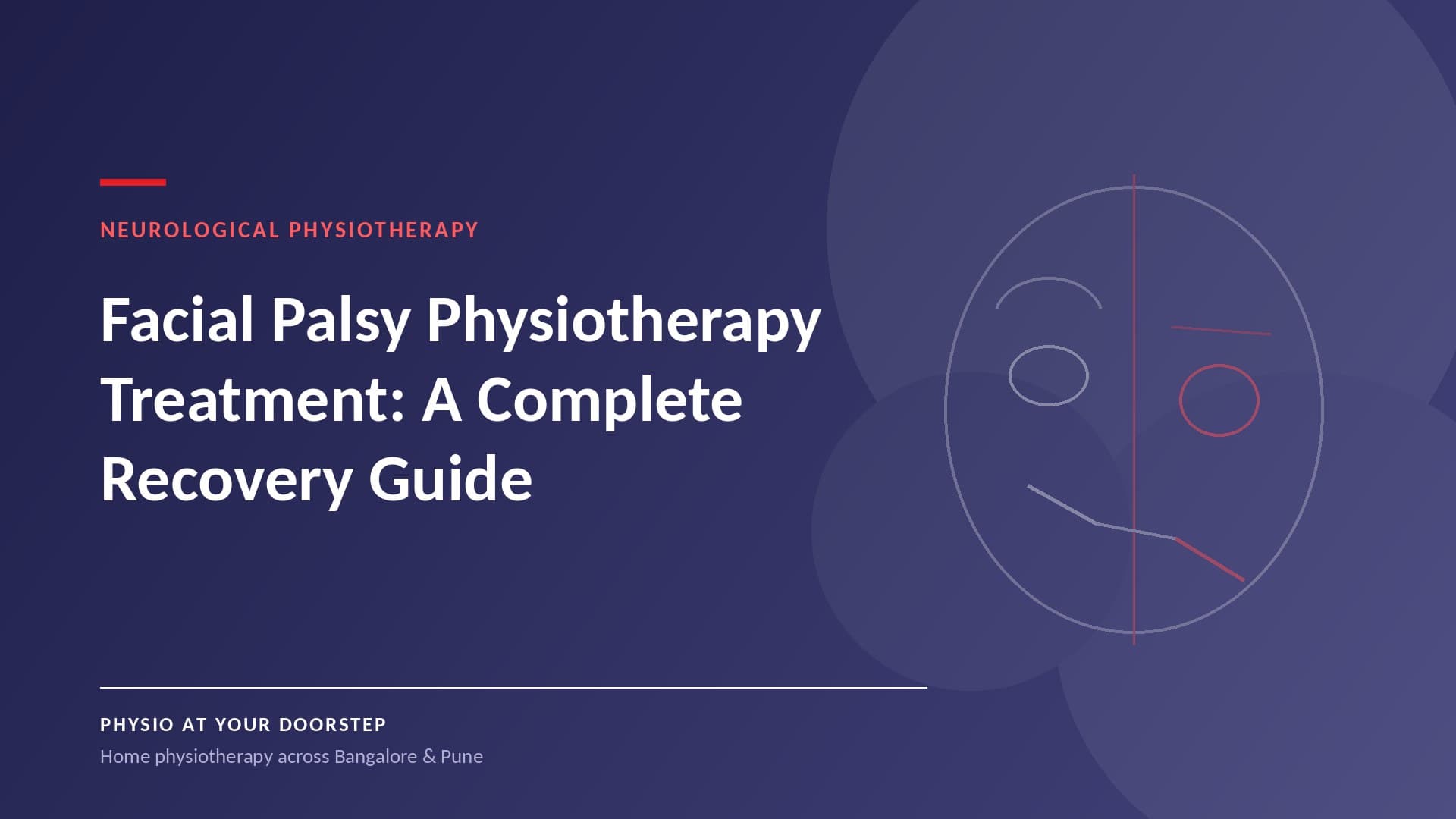
Waking up to find one side of your face drooping, an eye that will not close, or a smile that has gone crooked is frightening. Facial palsy affects not just how you eat, speak, and blink, but also how you express yourself and feel about your appearance. The good news is that with the right care, most people recover well, and facial palsy physiotherapy treatment plays a central role in that recovery.
This guide explains what facial palsy is, what causes it, and exactly how physiotherapy helps you regain facial movement, symmetry, and confidence. We have kept it clear and practical, backed by peer-reviewed research, so whether you are dealing with recent Bell's palsy or long-standing facial weakness, you know what your recovery can look like and when to seek help.
What Is Facial Palsy?
Facial palsy, also called facial nerve paralysis, is weakness or paralysis of the muscles of the face caused by damage to the facial nerve, which is the seventh cranial nerve. This nerve controls the muscles that let you smile, frown, close your eyes, raise your eyebrows, and move your lips. When it is damaged or inflamed, the messages from your brain to your facial muscles are disrupted, and one side of the face (occasionally both) stops working properly.
There is an important distinction that most articles skip, and it changes the treatment plan completely. Facial palsy is broadly divided into two types based on where the problem lies:
- Peripheral facial palsy (lower motor neuron) affects the facial nerve itself, usually causing weakness across the whole of one side of the face, including the forehead. Bell's palsy is the most common example.
- Central facial palsy (upper motor neuron) results from damage in the brain, such as after a stroke, and typically spares the forehead because of how the nerve pathways are wired.
Knowing which type you have matters, because central facial palsy often points to a condition like stroke that needs urgent medical attention, and its rehabilitation sits within broader neurological physiotherapy.
What Causes Facial Palsy?
The causes range from harmless and temporary to serious. The most common include:
- Bell's palsy: A sudden, one-sided facial paralysis caused by inflammation or compression of the facial nerve, with no clear identifiable cause. It is by far the most frequent, with a global incidence estimated at around 20 to 30 cases per 100,000 people each year.
- Ramsay Hunt syndrome: Caused by reactivation of the chickenpox virus around the facial nerve, often with a painful ear rash and blisters.
- Stroke: A neurological emergency that can cause central facial palsy, usually alongside other symptoms such as arm weakness or slurred speech.
- Trauma or fractures: Injury to the skull or face can damage the facial nerve directly.
- Post-surgical (iatrogenic) causes: Surgery near the facial nerve, such as for a tumour, can affect it. This kind of recovery often overlaps with post-surgical physiotherapy.
- Tumours and infections: Growths pressing on the nerve, or infections such as Lyme disease, can also be responsible.
Because the causes differ so widely, any new facial weakness should first be assessed by a doctor to confirm the diagnosis and rule out serious conditions before physiotherapy begins.
Common Symptoms of Facial Palsy
Facial palsy usually comes on quickly, sometimes overnight. Common signs include drooping on one side of the face, difficulty closing one eye or blinking, a crooked smile, drooling or difficulty eating and drinking, loss of the forehead crease on the affected side, changes in taste, increased sensitivity to sound in one ear, and difficulty with clear speech. Many people also notice the emotional weight of the condition. A 2011 study found that people with facial palsy were consistently perceived by others as having a more negative emotional expression, which shows why restoring facial movement matters for confidence and social life, not just function.
Why Physiotherapy Matters for Facial Palsy
Facial palsy physiotherapy, sometimes called facial neuromuscular retraining or facial nerve rehabilitation, helps you relearn how to move your facial muscles in a natural, coordinated way. It is a personalised program that aims to improve movement, symmetry, and control, and to prevent long-term complications.
The evidence supports it. A systematic review that evaluated seven randomised controlled trials, nine observational studies, and three pilot studies found evidence that facial exercise therapy can improve outcomes in facial palsy, although the authors noted the research base is varied and needs stronger, more consistent trials. In a documented case, a 75-year-old man with Bell's palsy who followed a structured eight-week physiotherapy program improved from grade IV to grade III on the House-Brackmann scale, regained facial symmetry, and recovered practical functions such as drinking from a cup and chewing. Research on mime therapy, which blends physiotherapy with expressive facial movement training, has also shown significant improvement in facial movement.
Physiotherapy does not force a nerve to heal faster than biology allows, but it keeps the muscles healthy while the nerve recovers, teaches correct movement patterns, prevents unhelpful habits, and addresses complications like synkinesis. That combination is why it is a core part of modern facial palsy treatment.
How Physiotherapists Assess Facial Palsy
Good treatment starts with careful assessment. Your physiotherapist will ask about how and when the symptoms started, then evaluate how your face moves at rest and during expressions such as raising the eyebrows, closing the eyes, smiling, and pursing the lips. To measure severity objectively and track progress over time, physiotherapists use standardised grading tools:
- The House-Brackmann scale grades facial function from grade I (normal) to grade VI (total paralysis), and is widely used to monitor recovery.
- The Sunnybrook Facial Grading System scores movement, symmetry at rest, and synkinesis, giving a more detailed picture that is especially useful in longer-standing cases.
These scores are not just paperwork. They let you and your therapist see real, measurable change and adjust the program based on how you are actually responding.
Facial Palsy Physiotherapy Treatment: A Phased Approach
Effective facial palsy rehabilitation is not a single set of exercises repeated forever. It changes as your nerve recovers, and matching the treatment to the stage is what separates expert care from a generic exercise sheet. Here is how a structured program typically progresses.
Phase 1: The Acute or Flaccid Stage (Protecting and Educating)
In the early stage, the affected muscles may not move at all, so aggressive exercise is not the priority. The focus is on protection and education. The single most important task is eye care. If you cannot close your eye fully, the cornea is at risk of drying out and being damaged, so lubricating drops, ointment, taping the eye at night, and protective glasses or goggles are essential. Your physiotherapist will teach you how to protect the eye, gently maintain tissue health with light massage, and understand what to expect. Forcing strong movements at this stage is discouraged, because it can encourage abnormal patterns later.
Phase 2: The Recovery Stage (Re-educating Movement)
As some movement returns, the program shifts to active facial retraining. This is where targeted facial exercises and neuromuscular re-education come in. Working in front of a mirror, you learn to produce small, correct, symmetrical movements rather than big, forceful ones. The aim is quality of movement, not strength alone. Slow, controlled, and frequent practice throughout the day tends to work better than occasional intense sessions.
Phase 3: The Chronic Stage and Synkinesis (Refining Control)
If facial palsy is long-standing, a common complication is synkinesis, where the nerve fibres reconnect incorrectly and one movement triggers another unwanted one, for example the eye narrowing whenever you smile. This is where physiotherapy is especially valuable and where many patients are wrongly told nothing more can be done. Neuromuscular retraining and mirror feedback exercises are the primary treatment for synkinesis, helping the brain relearn separate, controlled movements. In more stubborn cases, physiotherapy is often combined with botulinum toxin A injections given by a specialist. A study of 140 patients found that pairing neuromuscular retraining with botulinum toxin A improved functional outcomes for synkinesis, showing that even chronic facial palsy can keep improving with the right approach.
Key Physiotherapy Techniques and Facial Exercises
Within these phases, physiotherapists draw on several evidence-informed techniques. Your program will be tailored to your stage and cause, but the common tools include the following.
Facial retraining exercises. These are gentle, precise movements practised in front of a mirror, such as raising the eyebrows, slow and complete eye closure, wrinkling the nose, flaring the nostrils, puffing and holding air in the cheeks, gentle smiling with equal effort on both sides, and lip pursing. The goal is symmetry and control. Doing them with too much force can worsen synkinesis, so guidance matters.
Mirror therapy and biofeedback. Using a mirror gives you real-time visual feedback so you can see whether both sides of your face are moving evenly, which helps retrain the brain-to-muscle connection.
Proprioceptive neuromuscular facilitation (PNF). A hands-on technique used to stimulate and facilitate more symmetrical facial movement.
Facial massage and soft tissue work. Gentle massage helps maintain muscle tone, improve circulation, and reduce tightness, and is often introduced once early movement returns.
Kinesio taping. In some protocols, taping is used to support the affected muscles and gently assist symmetry.
Electrical stimulation: an honest note. You will see electrical stimulation offered widely for facial palsy, and some studies report benefit for maintaining muscle tone. However, the evidence is mixed and its use in Bell's palsy remains debated among experts, with concerns that it may contribute to synkinesis if used incorrectly. A good physiotherapist will treat it as an optional adjunct, not a default, and will make an individual decision based on your specific case rather than applying it to everyone.
Recovery Timeline: What to Realistically Expect
Recovery depends heavily on the cause and severity. For idiopathic facial palsy such as Bell's palsy, the outlook is generally encouraging. Research shows that even without intervention, around 71 percent of people with idiopathic facial palsy recover completely within one year, about 13 percent have mild residual weakness, and roughly 16 percent have a fair to poor recovery. Early physiotherapy aims to improve the odds of a fuller recovery and to support the group who do not resolve on their own.
Most people start to notice some improvement within a few weeks of consistent therapy, but complete recovery can take several months, and synkinesis management can be a longer journey. Consistency is the biggest predictor of success. Keeping a simple daily routine and tracking your progress, ideally alongside a physiotherapist reviewing your grading scores, makes a real difference over time.
Why Starting Early Matters
While the eye must be protected from day one, active facial retraining is timed to your recovery, not rushed. Even so, seeing a physiotherapist early has clear benefits. Early input means proper eye protection, correct education so you avoid habits that lead to synkinesis, emotional support during a stressful time, and expert monitoring so that the moment your muscles are ready for active work, the right exercises begin. Medical treatment such as corticosteroids also matters and is most effective when started within about 72 hours of symptom onset, so prompt medical review is important alongside physiotherapy.
Facial Palsy Physiotherapy at Home in Bangalore
If you or a loved one in Bangalore is dealing with facial palsy, you do not have to travel across the city for expert rehabilitation. Physio At Your Doorstep brings qualified physiotherapists directly to your home, so you can begin recovery in a calm, comfortable setting. This is especially helpful in the early stage, when stress and self-consciousness are high, and for elderly patients for whom clinic visits are tiring.
Led by Dr. Atharva Mishra, our team designs personalised facial retraining programs, guides you through correct eye care and mirror exercises, tracks your progress with objective grading, and adjusts your plan as your recovery moves through each phase. We serve 40 plus areas across Bangalore, including Koramangala, HSR Layout, Whitefield, Indiranagar, JP Nagar, Jayanagar, BTM Layout, Bellandur, Marathahalli, and Electronic City, with same-day home visits and support available around the clock.
Ready to start your recovery? Explore our neurological physiotherapy service, check whether we serve your area, or book an appointment today. You may be anywhere in Bangalore, and our physio will be there.
Helpful Resources
For readers who want to explore the clinical background and evidence further, these are reliable starting points:
- Facial Palsy — Physiopedia
- Physiotherapy Management of Bell's Palsy: A Case Report (PMC)
- The Use of Mirror Therapy in Peripheral Seventh Nerve Palsy: A Systematic Review (PMC)
You can also browse our full range of physiotherapy services or read more expert advice on our physiotherapy blog.
Frequently Asked Questions
Can physiotherapy cure facial palsy?
Physiotherapy does not cure the underlying nerve damage directly, but it plays a major role in recovery by keeping facial muscles healthy, retraining correct movement, improving symmetry, and managing complications like synkinesis. Research supports facial exercise therapy for improving outcomes, and many people achieve excellent functional recovery when physiotherapy is combined with appropriate medical care.
How long does it take to recover from facial palsy with physiotherapy?
Most people notice some improvement within a few weeks, while full recovery often takes several months. Around 71 percent of idiopathic facial palsy cases recover completely within a year. Recovery is generally faster and more complete with early, consistent, and correctly guided physiotherapy, though chronic cases and synkinesis can take longer.
What are the best exercises for facial palsy?
Effective exercises include gentle eyebrow raises, slow and complete eye closure, nose wrinkling, cheek puffing, controlled smiling with equal effort on both sides, and lip pursing, all done in front of a mirror. The key is small, precise, symmetrical movements rather than forceful ones. A physiotherapist should tailor the exercises to your stage, since the wrong exercises done too forcefully can worsen synkinesis.
Is electrical stimulation good for facial palsy?
It is debated. Some studies report benefit for maintaining muscle tone, but evidence is mixed, and there are concerns it may contribute to synkinesis if used incorrectly. It is best viewed as an optional adjunct decided case by case by a qualified physiotherapist, not a treatment for everyone.
What is synkinesis and can physiotherapy help?
Synkinesis is a common complication of long-standing facial palsy where nerve fibres reconnect incorrectly, so one movement triggers another unwanted one, such as the eye closing when you smile. Neuromuscular retraining and mirror feedback exercises are the main physiotherapy treatment for synkinesis, and in stubborn cases they are combined with botulinum toxin A injections for better results.
When should I start physiotherapy for facial palsy?
See a doctor promptly for diagnosis, since medication like corticosteroids works best within about 72 hours of onset. A physiotherapist can help from the earliest stage with eye protection and education, then begin active facial retraining as movement starts to return. Early guidance helps prevent the habits that lead to long-term complications.
Can facial palsy come back or become permanent?
Most cases of Bell's palsy resolve well, but a minority have lasting weakness or residual effects, and recurrence is possible in some people. Even in chronic or incomplete recovery, physiotherapy can continue to improve control and symmetry, so it is worth seeking assessment even if your palsy is long-standing.
Related Service
Neurological Physiotherapy at Home
Book a certified physiotherapist for neurological physiotherapy across Bangalore & Pune.
Related Articles
Advanced Neuro Physiotherapy Techniques: A Complete, Evidence-Based Guide
When the brain, spinal cord, or nerves are injured, the body often forgets how to move. Here are the ten advanced neuro physiotherapy techniques used today, the science behind each one, and which conditions they suit best.
Read More
Hemiplegia Treatment Physiotherapy Exercise: A Complete, Evidence-Based Recovery Guide
Hemiplegia appears in more than 80 percent of stroke survivors. Here are the physiotherapy exercises that actually work at each stage of recovery, how the Brunnstrom stages guide treatment, and what a realistic timeline looks like.
Read More
Autism Physiotherapy Treatment: Assessment and Management
If your child has recently been diagnosed with Autism Spectrum Disorder (ASD), you are probably trying to understand which therapies can genuinely make a difference to their day-to-day life. Physiotherapy is one of the most evidence-backed and underutilised supports available for children on the spe
Read MoreNeed Professional Help?
Our expert physiotherapists are here to help you recover and stay healthy.